People still ask how I made my own career change, and from the outside it can look quick and easy: corporate marketing one year, coaching practice the next. The truth is that it wasn’t quick, and it wasn’t easy. It took three years, from feeling quite consistently unsatisfied with work to finding work that actually fit. Three years of small experiments, dead ends, notebook pages and conversations before anything that looked like a decision.
In a form I did not expect, on a route I couldn’t have predicted.
I first wrote this story in 2020, eight months into running my own business, and I’ve kept the timeline below almost exactly as I told it then. I think the detail is the useful part: not “I changed career” but what I actually did, month by month, while still employed and mostly unsure.
How I found the work that felt right
We start where many thoughts about the future begin, one January:
January 2017
My thoughts were percolating. I was feeling a little unsettled with my role and work environment. I was enjoying lots of it still, but feeling a little unfulfilled. Over the months, as I distilled it down, I felt like I wanted to put my energy into something that would mean more to me, where I could see the value of my time being spent. I couldn’t work out how to do this at work, so I looked at how I could find it outside of work.
July 2017
I attended a Samaritans information evening. Samaritans is a charity providing emotional support to anyone in emotional distress, struggling to cope, or at risk of suicide. I felt really drawn to the mission and recognised the value that listening volunteers could bring. After the info evening, I signed up for training that September, and officially started as a listening volunteer in December 2017. Since then I’ve built over 325 hours of listening experience, and it remains one of the most purposeful things I have done with my time.
This was fulfilling in so many ways. It also gave me access to a different community of volunteers at my branch: different jobs, different careers, different stages of life. All sorts. Which was so refreshing for me. The biggest impact was learning that I really enjoyed it. I had followed my instinct to do something I thought I would love, without agenda, and it was paying off.
I was still feeling a dissonance with work, and Samaritans had opened up a whole set of strengths and thoughts I hadn’t really considered.
January 2018
The unsettled feeling at work still wasn’t going away. I needed to do more. I started carrying a small notebook a friend had given me to capture my thinking, and the first page reads:
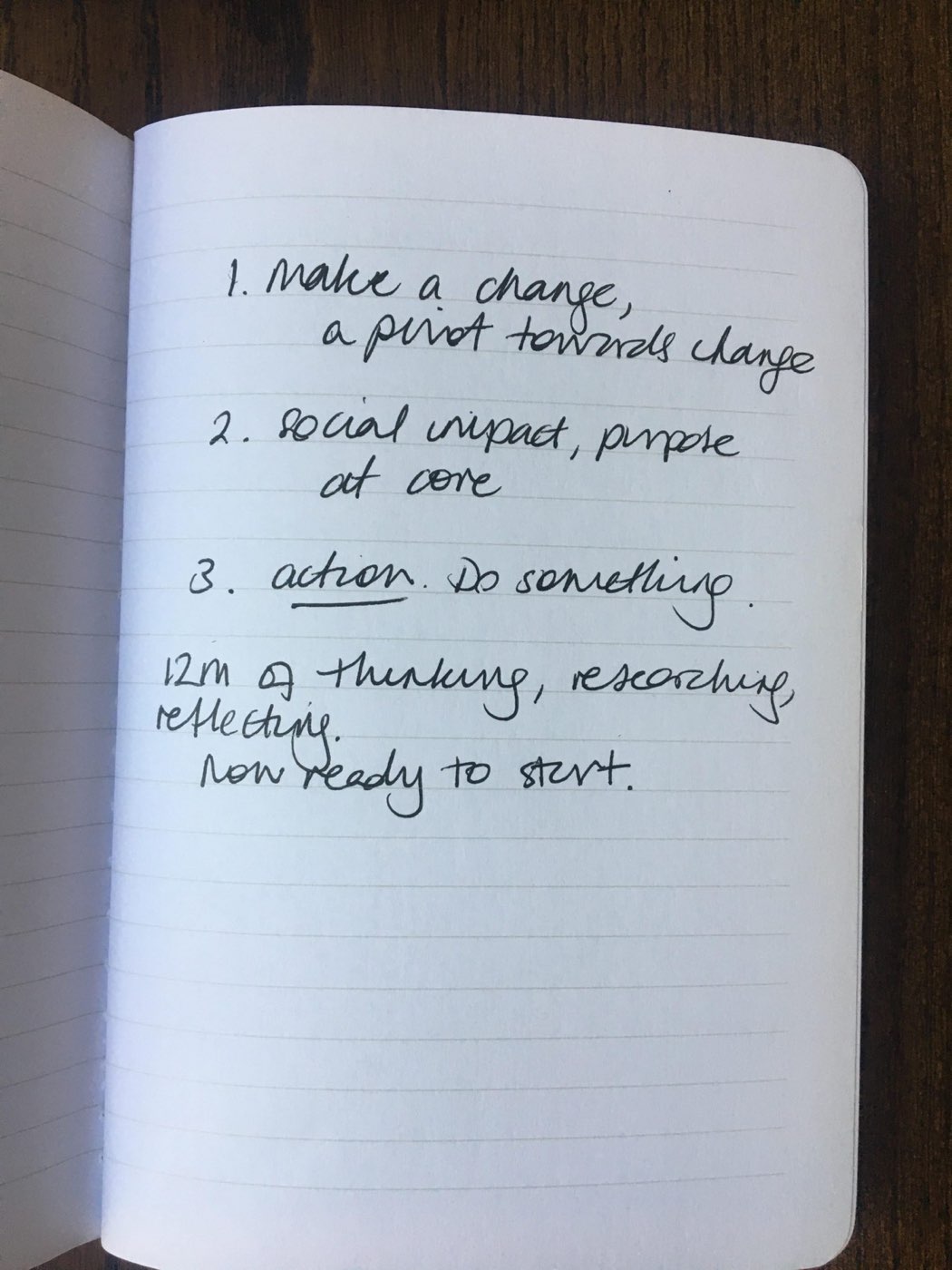
It was time to take action.
Over the months, I brainstormed everything I could think of that was possible, without filter or judgement. I watched webinars, read blogs, watched TED Talks. Basically fed my mind with ideas and experiences that were not naturally in my day-to-day sphere.
Two of the most impactful things I did were:
- I told the friends I felt comfortable with what I was doing. This created more conversations, more ideas, more reflections, and more people to talk to in my network’s network.
- I asked a handful of people I knew well what my strengths were.
From this I discovered a very clear trend. Everyone believed strongly that I was an excellent person to talk to: an excellent listener, the most non-judgemental and open-minded friend they could confide in. The extra bit I discovered, which I did not know, was that everyone also said I had a really interesting perspective. I didn’t see the challenges people brought in the same way others did, and that offered insights they valued. I was surprised to learn that the things people brought to me, they weren’t telling anyone else. And just how much value they placed on what they got back.
Those findings led to a conversation with a few friends about how my “research” was going, and one of them told me about coaching, and about Animas, a centre for coaching in the UK.
July 2018
I popped along to an Animas information day to learn more. I didn’t know much about coaching at all, and as the day went on I felt like this was exactly what I had been looking for. It played to my strengths, and it would stretch me to learn more about myself whilst gaining valuable skills. And no risk. I didn’t have to leave my job, move country, sign my life away. It needed financial investment and personal commitment, and I chose to give both.
At this point I had no idea what I would do with it in the short or medium term. It felt extracurricular. I was simply very drawn to learning more, without attachment to a plan.
Writing this now, one thing I did have in the back of my mind: I knew that eventually I wanted my work life to be more flexible. I wanted to be able to work from anywhere in the world, and I felt a pull to future-proof my career, to have the outline of a back-up plan if I ever reached the point where I couldn’t, or didn’t want to, progress further along the road I was on.
I think that thought was born from a lack of motivation in what I was doing, but also from an honest question about how much longer I wanted to work like this: putting so much into a job, being financially rewarded very well, and still not getting back the kind of value that made a difference to me.
October 2018
I started my Animas Diploma in Transformational Coaching. I loved it. I met so many like-minded people in similar situations. It was a breath of fresh air from the corporate job, and I felt quite alive learning and studying again. Except this time I wasn’t hitting in the dark at 18 about what was important to me. I was making a conscious, well-informed decision at 35 about what I wanted to spend my time learning.
January 2019
Whilst working on the diploma, I also put some feelers out for job opportunities. I had thought hard about what was making me unhappy in my current situation and concluded that the things bothering me (leadership, culture, politics, behaviours) were not in my control to change. So I had an idea of the variables I could switch to test whether another environment would change how work felt: a smaller company where I could have more impact, a more agile way of working, a culture of collaboration and positivity. I received an offer in April.
In the meantime I was coaching on the side, completing my training hours and writing my essays for qualification.
June 2019
I completed my diploma just in time to focus on a shiny new job that ticked the boxes I’d set out to look for. I still hadn’t really considered the qualification as a gateway to something different in the short term. And I think part of me wanted to know whether it was me or the environment making me unhappy at work. A new job would let me test that, and banish any “what ifs” from the future.
Six months later, I was still feeling unsettled. And I realised it wasn’t really the external factors. It was much more internal.
I had changed over those years, and not only because I’d learnt new things. Since January 2017 I had done a lot of reflecting and learning about myself, and the decisions and trajectory I’d set off on at 18 at university, then at 21 at the start of my career, were simply no longer in line with who I was now: my values, my strengths, and what I wanted, or what I was now capable of, from my working future. I understood myself much better.
I think on some level I had intended this all along, though it wasn’t clear to me at the time: I had given myself options for my future.
30th November 2019
I left my job, and for the first time since I was 21, I was unemployed.
Without a plan.
This sounds like it would have been scary, but I felt so liberated and free that it was incredibly invigorating. The disclaimer here is that I am not advocating leaving a job without another to go to, or without a plan. This is simply my account of what I did. I had been financially stable and well rewarded for a number of years and knew I had the means to be without an income for a few months.
I took December to reflect on this new energy, the freedom I felt, and what felt right and wrong as a next step. I felt new possibilities.
I had been coaching since starting the diploma in October 2018, and qualifying meant I had been doing it seriously alongside everything else. December gave me time to feel free of the corporate-robot feeling. And many people had begun saying the same thing: that I should do it as a business, that I would be really good at it. When people who knew me started saying they would pay for coaching with me, and would recommend me to friends and family, I had a realisation: this might actually work. I decided to give it a go, knowing I still had the skills and the network to return to my first career if it didn’t work out within twelve months.
January 2020
BOOM. I started my own coaching business.
September 2020
(As I wrote at the time:) I haven’t looked back once. Despite this being the strange year that it has been, I feel like I am in my element. I’m making a difference to myself and to others, and I am making money. This feels viable personally and commercially, in a way that makes me excited for the next 15 years of my new career.
Watch this space!
Reading it back in 2026
Six years on, the space got watched. The business became a transitions practice: I’ve now coached 400+ people through more than 1,600 hours, and I moved to Lisbon in 2021, which took care of the work-from-anywhere line that was sitting in the back of my mind in 2018.
Re-reading this made me smile the whole way through. I’m proud of the way I handled that transition. And with the eyes of someone who now does this for a living, I can see what was actually carrying me: openness. Experiments over decisions. Constant conversation with the people who knew me and cared about me. Small risks rather than big leaps. No rush for a solution, and (mostly) enjoying the process rather than gritting through it.
I can also see what the 2020 telling politely left out: the transition didn’t really start with work. It started with a relationship ending, and the sudden extra space that came with it, which pushed me to re-evaluate how I wanted to be in this new chapter. I notice the same thing in the people who come to me now. The presenting question is not the real focus. With a few good questions there’s usually a life event sitting underneath, quietly powering the restlessness. Transitions rarely start where they appear to start.
Almost every important move in the story was an experiment, not a decision. Samaritans. Asking friends what my strengths were. A diploma I called extracurricular. Even the 2019 job was a test with a hypothesis. Each experiment was based on some real evidence or instinct, and none of them required me to know the answer. Each one taught me something I couldn’t have thought my way to, and made the next small step clearer.
And I’ve realised the process still works, because I’m using it again. A different notebook, the same first page: the one that started these past months of clarifying and repositioning my own business. On that note I wrote about feeling at a plateau, on the edge of something and not knowing what was on the other side of it, but knowing that for me and my business to grow one step further, I would need to check, test and learn again. It turns out those three years didn’t just get me out; they taught me a process I get to keep, almost ten years later.
My change looked decisive from the outside. In reality, it was three years of attention, experiments and small choices.
What I have learnt
- Significant change is not easy or fast. It takes time and requires effort. And it is entirely possible.
- You have to take responsibility for the change you want.
- Even when you don’t know where to start, you have to start somewhere. Your values and strengths are a great place to begin: getting to know yourself is one sure way of slowly working out where to start.
- It is a process.
- Lean on the resources, the support network and the professional network you already have.
- I could have done it quicker with a coach…!
Read Part II of the story (2020 to 2023) here.
Does any of this resonate? You might be at one of the many stages I went through, or at the very start, not knowing where to start. If you’d like to talk about your own version, a first conversation is free and takes about 30 minutes. I’d love to hear more.