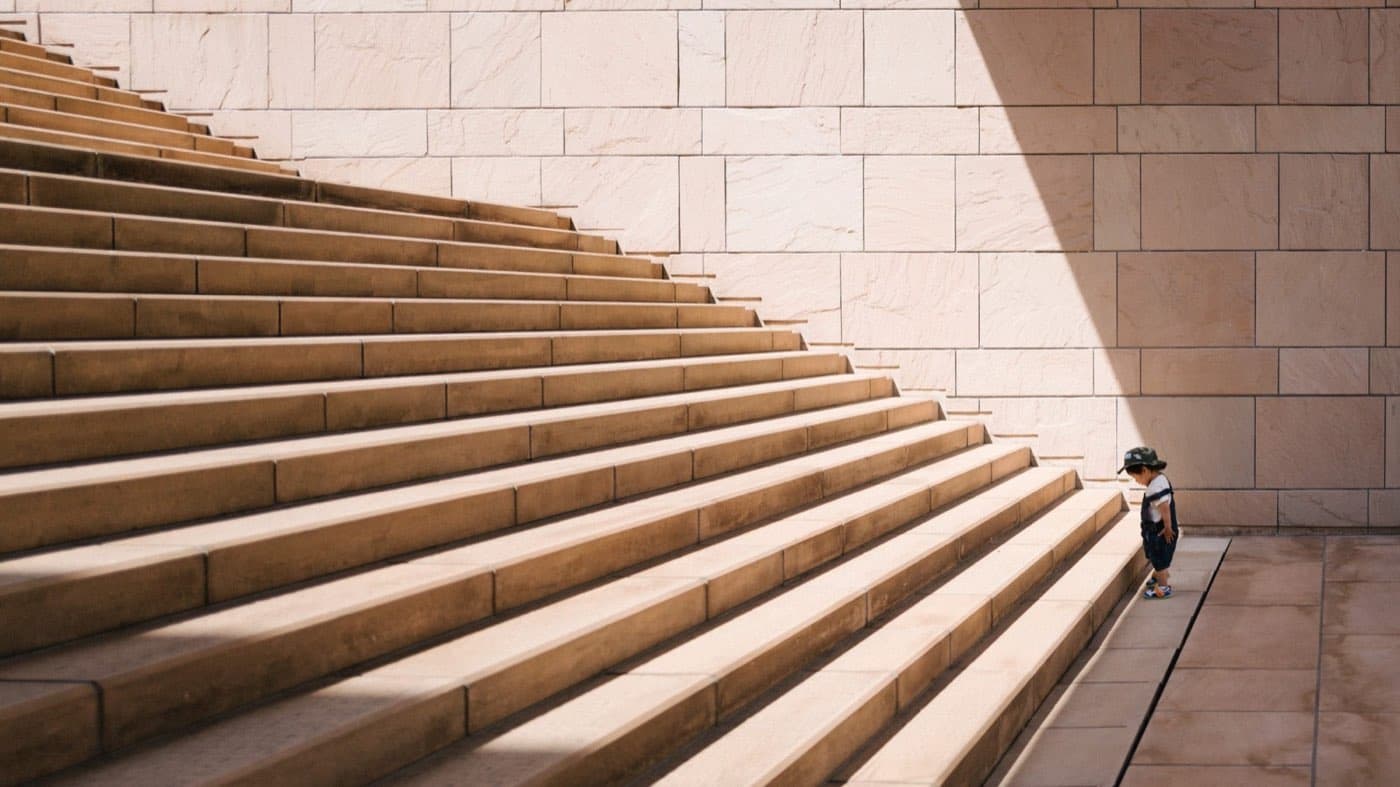
Recently, I was thinking about small steps. Often, when we think about a big change or significant transformation, it can be really overwhelming. We can forget that how we make the big change happen requires as much energy and focus as working out what the end goal is.
When did we forget about taking small steps to make a big change?
We all start with small steps, from the very basics of being very young: small steps to walk, literally. Small steps to learn, in education, in training, in building relationships, in developing our personalities, in gaining qualifications and work experience, in growing the capacity for emotional and mental maturity. It all takes small steps. Sometimes we’re not even aware each moment is a step, but we can see the pattern over time: we were able to do the big things because of all the small things that came before.
So when we take the big challenge, the big goal, the big transition, and break it into the steps needed to get there, does it become a little less overwhelming? Can it become a little less overwhelming? And a little more focused.
Could it be a way to move the energy from what we want to achieve to how we get there? Is that where the focus needs to go: into the how?
Many times the thinking jumps straight from realising you don’t have the goal to needing the goal immediately, and that is totally overwhelming, simply because big changes are not simple. They take time. And that time is not time for time’s sake. It is the time in which you take the small steps, make the incremental tweaks, reach the less visible but just as significant milestones.
What a small step actually looks like
Worth being concrete, because “take small steps” can sound like a platitude until you see the size of a real one. In a transition, a small step might be:
- One conversation with someone doing the thing you’re curious about
- A day shadowing someone, or an information evening attended
- An hour protected in the diary just to think, with your phone elsewhere
- Naming one fear on paper and deciding what to do with it
- Trying one different responsibility at work
- Saying out loud, to one trusted person, that something isn’t right
None of these commits you to anything. Each one produces information. That’s the real job of a small step: not progress for its own sake, but learning something you couldn’t have thought your way to.
And small does not mean passive
Choosing small steps isn’t playing safe or lacking ambition. It’s how ambitious change gets made by people who can’t afford to gamble everything on a guess. Each small step is an experiment; each experiment builds evidence; the evidence builds conviction; and conviction is what eventually makes the bigger move feel less like a leap and more like the obvious next step. The steps are small. The direction isn’t.
As a piece of graffiti in Lisbon once reminded me: big things have small beginnings.
So: do you have a big thing weighing on your mind?
Can you break that big thing into 3, 4, 5, 10 small steps? Can you list the ones you could take from now, to get you on your way to the big impact you want to see in your life?
If you can, you have somewhere to start. And if the big thing resists being broken down (it happens, especially when the big thing is still fuzzy), that’s a good conversation to have out loud: a first conversation is free and takes about 30 minutes.